Organoid Intelligence: Computing with Grown Brains
Organoid Intelligence (OI) is a research program to build functional computers out of living human brain tissue — and it is already in the lab.
The premise is straightforward and uncomfortable. Silicon-based computing is approaching thermodynamic limits. The human brain processes information at roughly 20 watts. The most efficient AI accelerators available today consume orders of magnitude more power per operation. Biology solved the efficiency problem three hundred million years ago. OI is the attempt to harvest that solution directly.
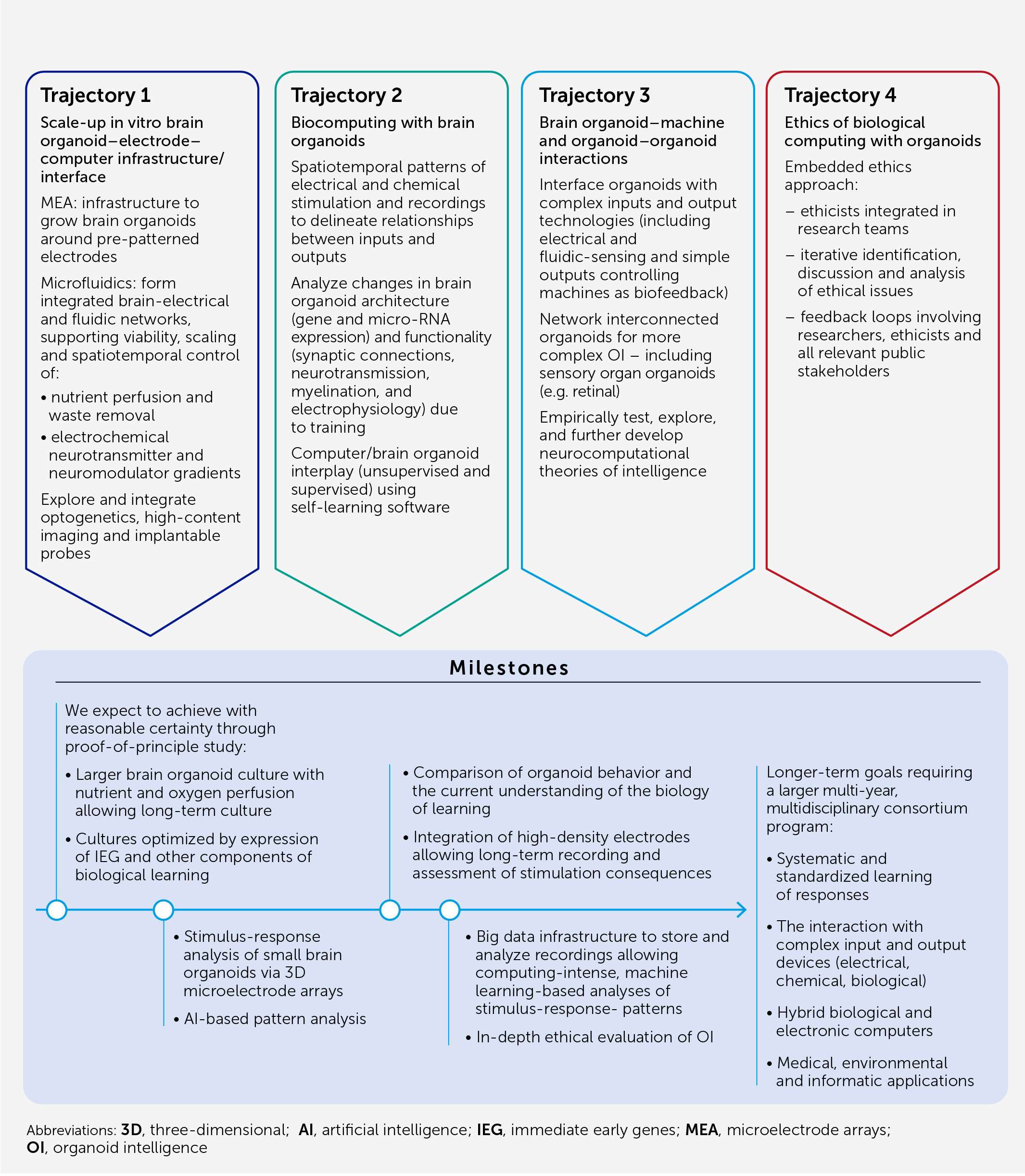
Timeline for OI developement
What Is Actually Being Built
The current research roadmap runs across four parallel trajectories, each a prerequisite for the next.
The first is infrastructure: growing brain organoids around pre-patterned multielectrode arrays, building microfluidic systems to handle nutrient perfusion and waste removal, integrating optogenetics and high-content imaging to maintain spatiotemporal control over living tissue at scale. This is the hardware problem — keeping the biology alive and readable.
The second is biocomputing proper: mapping the spatiotemporal patterns of electrical and chemical stimulation against outputs, tracking how organoid architecture — synaptic connections, neurotransmission, myelination, electrophysiology — changes in response to training. The question being asked is whether biological neural networks can learn in ways that are computationally useful, not just biologically interesting.
The third is interfacing: connecting organoids to complex input and output systems, networking multiple organoids together for more sophisticated processing, incorporating sensory organ organoids — retinal tissue is the leading candidate — as biological input channels. This is where OI stops being a neuroscience experiment and starts being a computing architecture.
The fourth trajectory runs alongside all three: embedded ethics. Not as a compliance checkbox but as a structural component — ethicists integrated into research teams from the start, iterative identification of ethical issues as capabilities develop, feedback loops involving researchers, ethicists, and public stakeholders. The program is designed around the assumption that questions of organoid moral status will need answers before the technology reaches application scale.
Why 2050+
The near-term milestones are deliberately modest. Proof-of-principle targets include stable long-term organoid cultures with nutrient and oxygen perfusion, stimulus-response analysis via 3D microelectrode arrays, and AI-based pattern analysis of organoid behavior. These are not computing demonstrations. They are existence proofs — establishing that the substrate can be controlled and read consistently enough to build on.
The medium-term targets require what the roadmap honestly calls “a larger multi-year, multidisciplinary consortium program.” Systematic and standardized learning responses. Interaction with complex electrical, chemical, and biological input/output devices. Hybrid biological-electronic computers. Medical, environmental, and informatics applications.
The gap between those two phases is not an engineering gap. It is a biological knowledge gap. We do not yet have a complete model of how biological neural networks encode, store, and retrieve information at the level of precision required to engineer reliable computation. OI is downstream of that understanding — which means its timeline is downstream of neuroscience itself.
What Changes If It Works
The efficiency argument is the obvious one. Biological neural computation at scale would make current AI infrastructure look like a steam engine next to a turbine. But the more significant implication is architectural. Silicon computing is deterministic by design — OI is inherently probabilistic, adaptive, and self-modifying in ways that no current architecture is. The applications that become possible are not faster versions of what exists now. They are qualitatively different.
The medical applications are the nearest-term. Organoids derived from patient tissue could model neurological disease, test drug responses, and eventually interface with biological systems in ways that implanted electronics cannot. The computing applications are longer and harder. The ethical questions about the moral status of trained, networked organoids — tissue that has learned, that responds, that may in some meaningful sense experience — have no settled answers yet.
OI is not a 2030 story. It is not a 2040 story. It is the infrastructure being laid now for a question that will become unavoidable sometime in the second half of this century: what counts as a mind, and what rights follow from that.